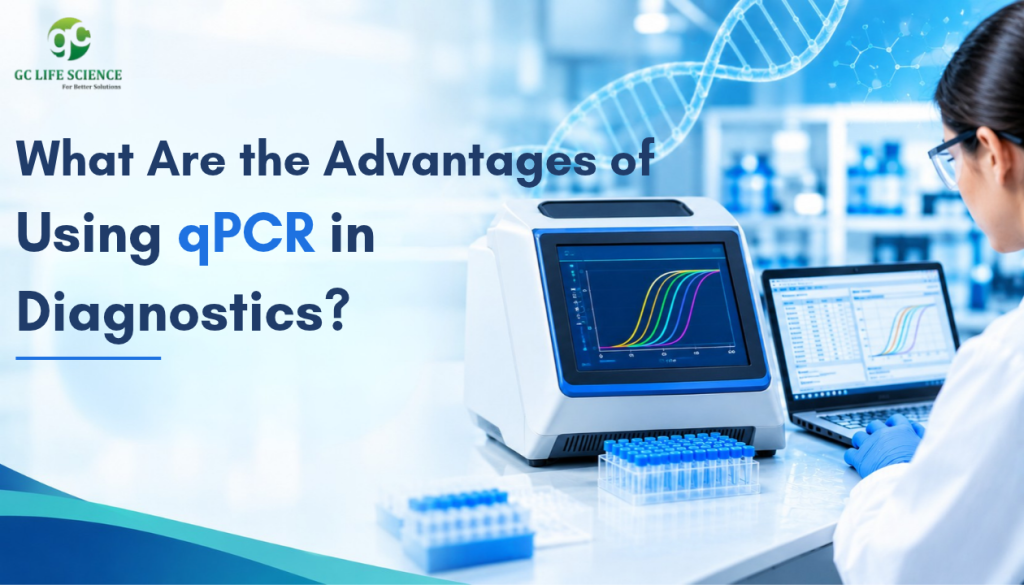
qPCR offers sensitive detection, rapid results, accurate quantification, and reliable genetic analysis, supporting infectious disease testing, oncology, and molecular diagnostics.
Quantitative polymerase chain reaction (qPCR) is an important technique used in modern molecular diagnostics to detect and measure specific genetic material in biological samples.
It monitors DNA amplification in real time, while RT-qPCR is used to analyze RNA after converting it into complementary DNA. qPCR is widely applied in infectious disease testing, genetic research, oncology, and disease monitoring because it offers sensitive detection, quantitative results, and relatively fast analysis.
Reliable testing depends on suitable laboratory instruments, quality PCR and qPCR reagents, and effective DNA and RNA extraction methods. GC Life Science supports laboratories with molecular diagnostics products, reagents, kits, and instruments.
What Is qPCR in Diagnostics?
Quantitative PCR, also called qPCR or real-time PCR, is a method used in a lab to copy specific DNA parts and track how much DNA is being copied by measuring fluorescent signals. The target genetic material can be analyzed by laboratories through the measurement of fluorescence in each PCR cycle.
Unlike regular PCR, which usually checks the results after the reaction is done, qPCR watches the amplification happen as it’s happening. This allows us to find out how much of the target DNA is in a sample if we use the right method for measuring it.
For RNA-based testing, RT-qPCR includes an additional reverse transcription step that converts RNA into complementary DNA (cDNA). This approach is used in selected infectious disease tests, gene expression studies, and other molecular applications.
In diagnostic laboratories, qPCR can help detect specific genetic targets associated with microorganisms, genetic variations, and other biological conditions. The results must be interpreted according to the validated test method, quality controls, and intended clinical application.
What Are the Advantages of Using qPCR in Diagnostics?
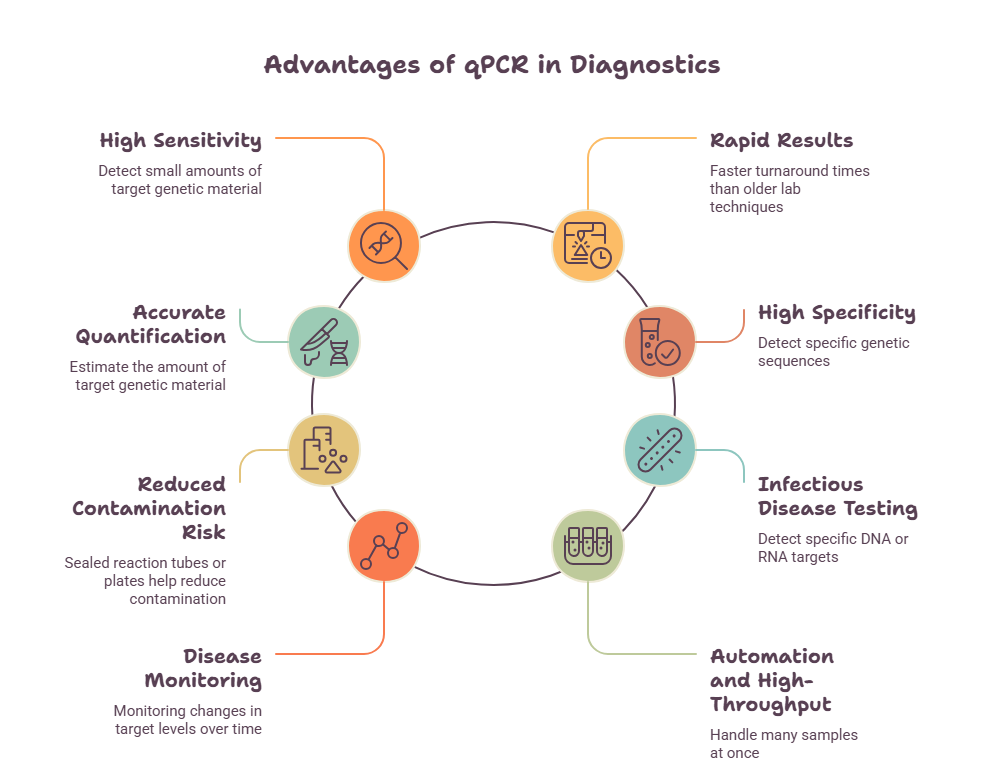
qPCR offers several advantages that make it useful for modern molecular diagnostic workflows. The main benefits include sensitive detection, quantitative analysis, faster turnaround times, and compatibility with automated laboratory processes.
1. High Sensitivity
One of the major advantages of qPCR is its ability to detect small amounts of target genetic material when the assay is appropriately designed and validated.
The sensitivity of a sample is crucial when there is a low concentration of the target DNA or RNA. Some tests look for genetic material from infectious germs using a method called qPCR.They also use this technique to keep track of certain markers in the DNA.
High analytical sensitivity is affected by several things, like the quality of the sample, how well the nucleic acid is extracted, the design of the primers and probes, how the reagents work, and the type of instrument used.
Laboratories should use validated methods and appropriate controls to help ensure that the assay performs according to its intended requirements.
2. Rapid Results
qPCR can give results much faster than some older lab techniques. Because the amplification and fluorescence detection happen at the same time in the reaction, labs can watch the process as it happens without needing another step after the amplification is done.
The total turnaround time depends on sample collection, DNA and RNA extraction, reaction preparation, amplification, and result interpretation.
Faster molecular testing can support timely laboratory reporting and help healthcare professionals make decisions when results are available and clinically appropriate.
3. Accurate Quantification of Genetic Material
Another important advantage of qPCR is its ability to estimate the amount of target genetic material in a sample.
Quantitative analysis can be done by using proper calibration standards or by applying tested comparison methods. The right method depends on whether the lab is checking the actual amount, the comparison between amounts, or some other specific measure.
For example, quantitative PCR is used for monitoring BCR-ABL transcript levels in chronic myeloid leukemia (CML). When results are measured using validated methods and reported on the International Scale, they can help physicians assess molecular response over time.
This application demonstrates how qPCR can provide more information than simply detecting the presence or absence of a target.
4. High Specificity
qPCR assays are designed to detect specific genetic sequences using primers and, in many assays, fluorescent probes. Properly designed primers and probes help distinguish the intended target from unrelated genetic material.
Specificity is important in molecular diagnostics because the presence of non-target sequences should not be incorrectly interpreted as the presence of the target.
However, how well an assay works depends on how the primers and probes are made, the conditions used in the reaction, the quality of the sample, and how well it’s tested.
Laboratories need to follow the instructions provided by the manufacturer and use proper positive and negative controls to check how well the test works.
5. Reduced Risk of Contamination
Many real-time PCR processes use sealed reaction tubes or plates for amplification and fluorescence measurement. This helps reduce the need to open samples that have been amplified, which lowers the chance of contamination during handling after the reaction.
Contamination prevention remains important during sample collection, nucleic acid extraction, reagent preparation, and reaction setup.
Laboratories should maintain appropriate work areas, follow standard operating procedures, and use contamination-control measures to support reliable molecular testing.
6. Useful for Infectious Disease Testing
qPCR and RT-qPCR are used in many molecular tests for infectious diseases. Depending on the validated assay, these techniques can detect specific DNA or RNA targets associated with bacteria, viruses, and other microorganisms.
Molecular testing can be useful when the target genetic material is difficult to identify using other methods or when rapid detection is required.
The interpretation of results depends on the specific test, the type of sample, and the clinical context. A positive molecular result does not always establish whether an organism is viable or whether it is responsible for a patient’s symptoms.
7. Supports Disease Monitoring
qPCR is useful not only for detecting genetic material but also for monitoring changes in target levels over time.
For example, BCR-ABL quantitative PCR is used to check how well a patient’s condition is improving in those with Philadelphia chromosome-positive chronic myeloid leukemia (Ph+ CML).
Serial results can help doctors see how a treatment is working and spot any changes that might need more attention.
Other tested methods can be used to track specific molecular markers or look at how gene expression changes.
Treatment decisions should always be based on the complete clinical picture, established guidelines, and appropriate specialist assessment rather than a single laboratory result.
8. Suitable for Automation and High-Throughput Testing
Modern real-time PCR machines have features that help follow standard procedures and handle many samples at once.
Laboratories can use automated methods to extract nucleic acids, pre-made reaction mixtures, and matching software to make testing more efficient, depending on the type of instrument and test being used.
Automation can help reduce repetitive manual work and improve workflow consistency. It may also support better laboratory productivity when sample volumes increase.
Laboratories should check instrument compatibility, sample capacity, reagent requirements, and workflow design before introducing a new qPCR system.
Major Applications of qPCR in Molecular Diagnostics
qPCR is used across different laboratory and research settings. Its application depends on the target being analyzed and the availability of an appropriate validated assay.
1. Infectious Disease Diagnostics
qPCR and RT-qPCR can detect specific microbial DNA or RNA targets in suitable clinical samples. These techniques are used in selected tests for bacterial and viral infections.
2. Oncology and Cancer Research
Molecular oncology laboratories use PCR-based techniques to investigate selected genetic changes, gene expression, and disease-associated molecular markers.
Quantitative PCR may also be used for monitoring specific molecular targets, including BCR-ABL transcripts in CML.
Other methods like fluorescence in situ hybridization (FISH) and DNA sequencing give extra information that is useful for various uses. The decision is based on the clinical or research question.
3. Genetic Research
qPCR is widely used in gene expression analysis and molecular biology research.
Researchers can compare the expression of selected genes across samples using appropriate reference genes and validated analytical methods.
4. Microbiology and Biotechnology
In microbiology and biotechnology research, qPCR can help detect specific microbial targets, study genetic material, and investigate biological processes. It can also be used in selected quality-control and research workflows.
Role of DNA and RNA Extraction in qPCR Testing
Reliable qPCR results depend on the quality of the starting sample. DNA and RNA extraction is an important step because impurities, degraded nucleic acids, or substances that inhibit PCR can affect assay performance.
DNA extraction is used when the target is DNA, while RNA extraction is required for RNA-based assays that use reverse transcription before qPCR.
Laboratories need to choose the right molecular extraction kits based on the type of sample, the material they are looking for, and what they plan to do with the results later. They should also follow the recommended storage conditions and sample-handling procedures.
Good extraction techniques, right PCR materials, and proper checks help labs keep their molecular testing processes reliable and consistent.
How GC Life Science Supports Molecular Diagnostics Laboratories
GC Life Science is a company based in Jaipur that provides molecular diagnostic tests and life science products to laboratories, hospitals, research institutes, and biotechnology companies.
Since 2014, the company has been concentrating on providing products used in molecular biology, diagnostics, and lab research.
Its product portfolio includes laboratory instruments, molecular biology reagents, DNA and RNA extraction products, PCR and qPCR solutions, and next-generation sequencing-related products.
GC Life Science works with established life science brands, including Qiagen, Promega, Eppendorf, Takara, and Real Gene, to support different laboratory requirements.
Laboratories looking for molecular extraction products, PCR reagents, molecular oncology solutions, or sequencing-related products can explore the available range and identify products suited to their intended applications.
Visit the official website to explore laboratory products and molecular diagnostics solutions: https://gclifescience.com/
Conclusion
qPCR is a key method used in today’s medical testing because it can detect small amounts of genetic material, measure how much is present, give quick results, and work well with standard lab procedures.
It is used for testing infectious diseases, cancer-related work, genetic studies, microbiology, and keeping track of diseases.
However, getting accurate results relies on proper testing setup, good sample condition, correct DNA and RNA collection, matching chemicals, working equipment, and proper checks to make sure everything is done right. Laboratories need to closely look at these factors when choosing molecular diagnostic tests.
GC Life Science supports laboratories with molecular diagnostics products, PCR and qPCR reagents, DNA and RNA extraction solutions, laboratory instruments, and other life science products.
Visit https://gclifescience.com/ to explore available products for your laboratory and research requirements.
FAQ’s
1. What is qPCR in diagnostics?
qPCR is a molecular technique that amplifies specific DNA sequences and monitors the amplification process in real time. RT-qPCR is used for RNA targets after reverse transcription.
2. What are the main advantages of qPCR?
The main advantages include high analytical sensitivity, quantitative analysis, relatively rapid results, target specificity, reduced post-amplification handling, and compatibility with automated workflows.
3. What is the difference between PCR and qPCR?
Conventional PCR generally detects amplified DNA after the reaction is complete. qPCR monitors amplification through fluorescence during each cycle, allowing real-time detection and, with suitable methods, quantification.
4. Is qPCR used for infectious disease testing?
Yes. Validated qPCR and RT-qPCR assays can detect specific DNA or RNA targets associated with various infectious microorganisms.
5. How accurate is qPCR testing?
Accuracy depends on assay validation, sample quality, extraction efficiency, reagent performance, instrument calibration, and laboratory procedures. Appropriate controls are important for evaluating test reliability.
6. Why is DNA and RNA extraction important in qPCR?
Extraction isolates nucleic acids from biological samples. Good-quality DNA or RNA helps support the amplification process, while contaminants or degraded material may affect results.
7. Can qPCR be used in oncology?
Yes. qPCR can be used to investigate selected molecular markers and monitor specific genetic targets, such as BCR-ABL transcripts in chronic myeloid leukemia, when appropriate validated assays are used.
8. What laboratory products are needed for qPCR testing?
Depending on the workflow, laboratories may require extraction kits, PCR or qPCR reagents, primers, probes, compatible real-time PCR instruments, and suitable quality-control materials.
9. Does qPCR always provide a diagnosis on its own?
No. Results must be interpreted according to the test’s intended use, analytical limitations, and relevant clinical information. Some conditions require additional laboratory tests or clinical assessment.
10. Where can laboratories find molecular diagnostics products in India?
GC Life Science supplies molecular diagnostics products, laboratory instruments, PCR and qPCR solutions, extraction products, and other life science supplies. Visit https://gclifescience.com/ to explore its available product range.