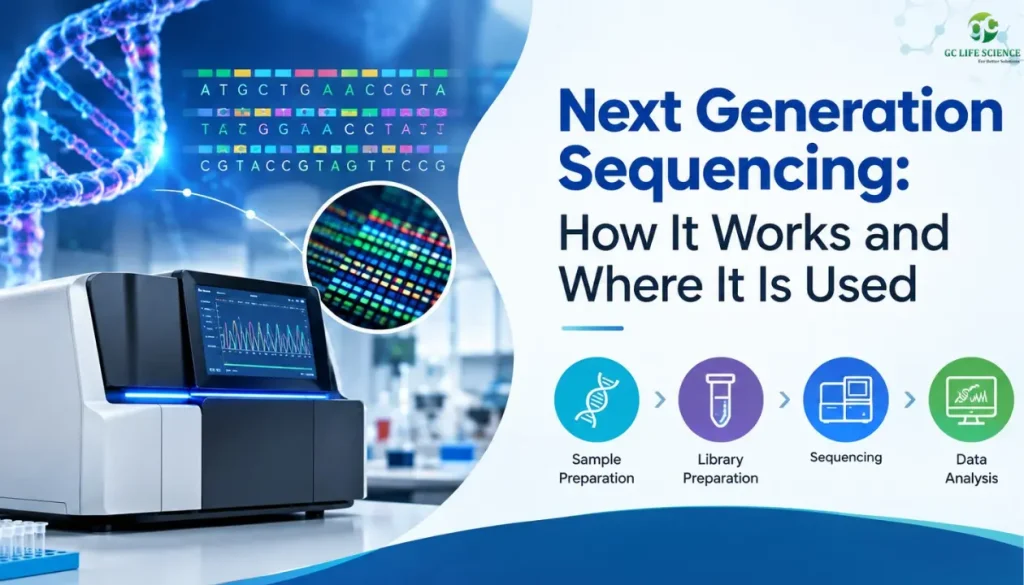
Next Generation Sequencing is a high-throughput technology that analyzes millions of DNA fragments simultaneously for genomic research, diagnostics, and molecular applications.
Next Generation Sequencing (NGS) has transformed how labs study DNA and RNA by letting them look at millions of genetic sequences at the same time. Unlike older methods that look at one piece of DNA at a time, next-generation sequencing can handle many DNA pieces all at once.This makes it very helpful for studying genes, researching cancer, doing genetic tests, and other similar tasks.
With the increasing demand for advanced genomic technologies, laboratories need reliable instruments, reagents, kits, sample preparation products, and supporting solutions for their sequencing workflows. NGS Solutions in Jaipur can support research laboratories, diagnostic facilities, hospitals, biotechnology companies, and academic institutions working with modern sequencing applications.
What Is Next Generation Sequencing?
Next Generation Sequencing is a high-throughput sequencing technology used to determine the order of nucleotides in DNA or RNA-derived libraries. The main advantage of NGS is its ability to sequence a large number of DNA fragments at the same time.
A usual NGS process has many key steps, beginning with getting ready the sample and extracting the nucleic acids. The DNA or RNA that is taken out is then prepared to make a sequencing library. The ready-made library is placed on an NGS sequencing machine, and millions of DNA pieces are read at the same time.
After sequencing, the generated reads are processed using bioinformatics tools. Next generation sequencing data analysis helps researchers identify genetic variants, mutations, changes in gene expression, and other genomic information according to the purpose of the study.
How Does Next Generation Sequencing Work?
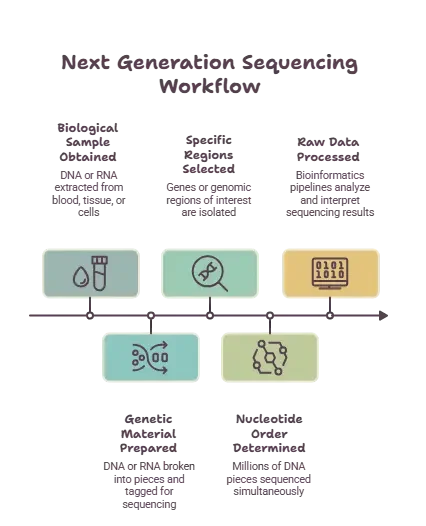
The NGS process involves multiple laboratory and computational steps. Each stage contributes to the quality and reliability of the final sequencing data.
1. Sample Collection and Nucleic Acid Extraction
The workflow begins with a biological sample such as blood, tissue, cells, or another suitable specimen. DNA or RNA is extracted from the sample using appropriate extraction methods.
High-quality nucleic acid is important because poor-quality or insufficient DNA or RNA can affect downstream library preparation and sequencing results. Proper sample handling, extraction reagents, and laboratory consumables therefore play an important role in an NGS workflow.
2. Library Preparation
After extraction, the DNA or RNA is prepared for sequencing. This stage is known as library preparation.
During the library preparation process, the genetic material is broken into smaller pieces or treated based on the chosen sequencing method. Special tools are attached to the DNA pieces so that they can be copied, recognized, and handled by the sequencing machine.
The exact library preparation process depends on the type of NGS application, sample type, and sequencing technology being used.
3. Target Enrichment or Amplification
Some NGS workflows analyze a specific group of genes or genomic regions rather than the complete genome. Target enrichment methods can be used to select the regions of interest.
PCR-based amplification may also be included in certain library preparation workflows. The objective is to prepare sufficient and suitable sequencing material for the next stage.
4. Sequencing
The prepared library is then introduced into an NGS sequencing instrument.
While sequencing, the system looks at the order of nucleotides in millions of DNA pieces all at the same time. Depending on the type of sequencing technology used, various chemical or detection techniques are applied to recognize the bases during the sequencing process.
This massively parallel approach allows laboratories to generate a large amount of sequencing information from a single experiment.
5. Data Generation and Analysis
Sequencing produces large amounts of raw data. These data need to be processed using bioinformatics pipelines before they can be interpreted.
Next generation sequencing data analysis can involve checking the quality of the data, aligning the reads to a reference genome, finding genetic variations, adding information about those variations, and explaining what they mean.
The specific analysis will vary based on whether the project is focused on cancer research, inherited diseases, microbial genetics, studying gene activity, examining the entire protein-coding region of the genome, analyzing the whole genome, or another type of application.
What Are the Main NGS Approaches?
NGS can be used through different approaches depending on the research or diagnostic objective.
Targeted Sequencing
Targeted NGS focuses on selected genes or genomic regions. It can be useful when researchers already know which genes or mutations they want to investigate.
Because the analysis is focused on specific regions, targeted sequencing can be suitable for applications requiring detailed examination of a defined set of genes.
Whole Exome Sequencing
Whole Exome Sequencing (WES) mainly looks at the parts of the genome that code for proteins, which are called exons. Even though these areas make up just part of the whole genome, they include a lot of different gene variations that are important for studying genetics and diseases.
WES is commonly used in research involving inherited disorders, rare diseases, and genomic variation.
Whole Genome Sequencing
Whole Genome Sequencing (WGS) examines the complete genomic sequence, including both coding and non-coding regions.
It can provide a broader view of genetic variation and is used in areas such as human genomics, population studies, disease research, and microbial genomics.
RNA Sequencing
RNA sequencing, commonly known as RNA Seq, uses NGS technology to study RNA molecules and gene expression.
Researchers can use RNA Seq to investigate which genes are expressed, how expression changes under different conditions, and how biological pathways are affected.
Where Is Next Generation Sequencing Used?
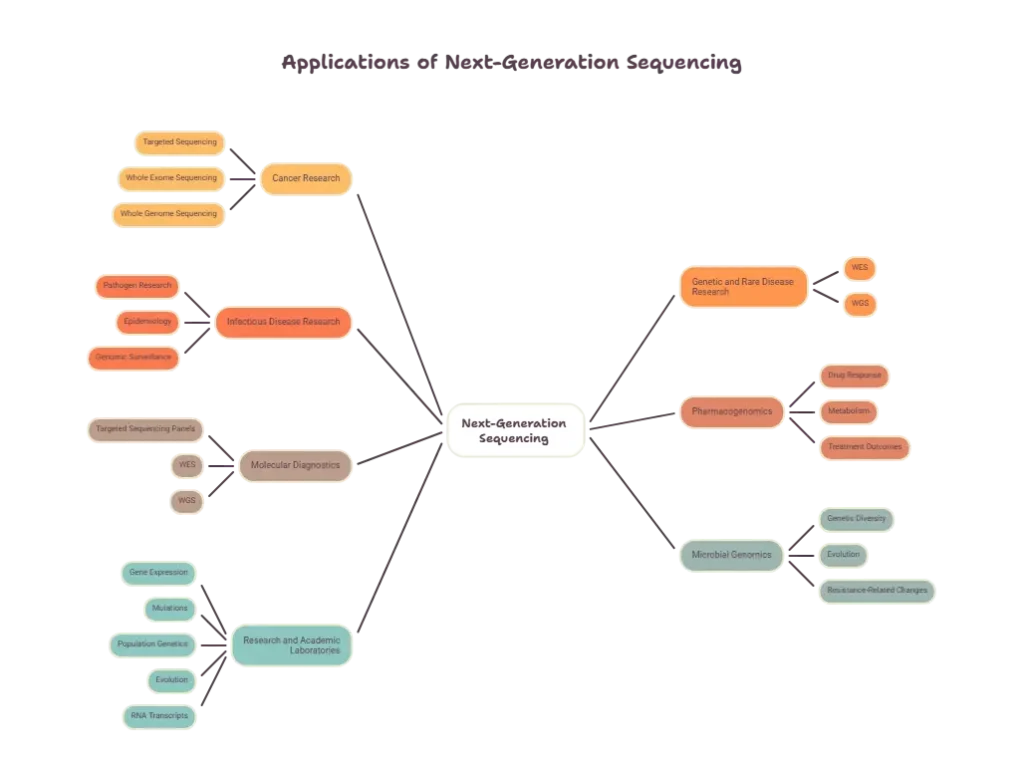
The applications of NGS have expanded across research, healthcare, biotechnology, and molecular biology.
1. Cancer Research
NGS plays an important role in cancer research by allowing researchers to investigate mutations, gene alterations, and other genomic changes associated with tumors.
Targeted sequencing, whole exome sequencing, and whole genome sequencing can help scientists look into the genetic features of various cancers and find out the molecular changes that can be studied more deeply.
2. Genetic and Rare Disease Research
NGS can be used to investigate genetic variants associated with inherited and rare diseases. WES and WGS are particularly useful when researchers need to examine a large number of genes or the broader genome.
These approaches can support research into the genetic causes of complex or uncommon conditions.
3. Infectious Disease Research
NGS can also be used to study bacteria, viruses, fungi, and other microorganisms. Sequencing allows scientists to look at microbial genomes, find differences in their genes, and watch how these microbes change over time.
This makes NGS valuable for pathogen research, epidemiology, and genomic surveillance.
4. Pharmacogenomics
Pharmacogenomics examines how genetic differences can influence responses to medicines.
NGS can help researchers investigate genetic variants that may be associated with drug response, metabolism, or treatment-related outcomes. This area supports research into more personalized approaches to healthcare.
5. Molecular Diagnostics
NGS can support molecular diagnostic workflows where analysis of multiple genes or genomic regions is required.
Depending on the intended application, laboratories may use targeted sequencing panels, WES, WGS, or other sequencing approaches to investigate genetic alterations.
6. Microbial Genomics
Researchers can sequence microbial genomes to study genetic diversity, evolution, resistance-related changes, and other biological characteristics.
NGS provides a high-throughput approach for studying large numbers of microbial sequences and comparing genomic data.
7. Research and Academic Laboratories
Universities, biotech firms, and research organizations use next-generation sequencing for many different projects related to genetics and molecular biology.
These tools can be used for studying how genes are expressed, looking at mutations, understanding genetic differences in populations, researching evolution, analyzing RNA transcripts, and other types of genetic studies.
What Is Required for an NGS Workflow?
A successful NGS workflow requires more than just a sequencing instrument. Laboratories need suitable products and supporting systems at different stages of the process.
Important requirements may include:
- DNA and RNA extraction systems
- Nucleic acid purification products
- PCR and amplification reagents
- Library preparation kits
- Target enrichment solutions
- Sequencing reagents
- Laboratory consumables
- Sample storage products
- Quality control instruments
- Bioinformatics and data analysis tools
The exact requirements depend on the sample type, sequencing platform, application, and research objective.
Choosing NGS Solutions for Your Laboratory
Selecting the right NGS solution depends on several factors. Laboratories should consider the type of samples being analyzed, the number of genes or genomic regions being studied, sequencing requirements, library preparation method, expected data volume, and downstream analysis needs.
The lab should also think about the product’s quality, get help with technical issues, make sure there are enough reagents and supplies available, provide clear instructions, and check if everything works well with the planned process.
For labs in Jaipur that need NGS solutions, partnering with a trusted lab product supplier can help get the necessary instruments, reagents, kits, and other supporting items needed for various molecular biology and sequencing tasks.
NGS Solutions from GC Life Science
GC Life Science is located in Jaipur, Rajasthan, and provides laboratory equipment, reagents, specialized kits for different uses, chemicals, plastic labware, and glass labware for scientific and diagnostic purposes. The company also offers technical support, tailored laboratory solutions, and product distribution throughout India.
Its product portfolio includes globally recognized brands such as QIAGEN and Promega, along with other laboratory brands.
For laboratories working with molecular biology, genomic research, sequencing-related workflows, and diagnostic applications, GC Life Science can provide supporting laboratory products according to specific technical and application requirements.
Conclusion
Next Generation Sequencing has become an important technology for genomic research, molecular diagnostics, cancer studies, and genetic analysis. From sample preparation and library preparation to sequencing and next generation sequencing data analysis, each stage plays an important role in generating useful genomic information.
A reliable workflow may require high-quality Nucleic Acid Extraction solutions, suitable PCR Kits, library preparation products, sequencing reagents, and supporting laboratory consumables. GC Life Science provides NGS Solutions for laboratories working across research and diagnostic applications.
Its product range also helps meet molecular testing needs by offering solutions for advanced oncology diagnostics in Rajasthan, covering cancer and genetic testing processes. For labs in Jaipur needing NGS solutions, GC Life Science can offer the right products and technical help tailored to their specific application and workflow needs.
Request Product Information Today to explore laboratory solutions for your NGS and molecular biology needs.
FAQ’s
1. What is Next Generation Sequencing?
Next Generation Sequencing is a high-throughput technology that reads millions of DNA fragments in parallel for genomic research and molecular analysis.
2. How does Next Generation Sequencing work?
NGS generally involves nucleic acid extraction, library preparation, sequencing, data generation, and bioinformatics analysis to obtain useful genomic information.
3. What is a Next Generation Sequencing method?
A Next Generation Sequencing method is a high-throughput sequencing approach that processes many DNA fragments simultaneously using specialized sequencing technologies.
4. What is NGS sequencing used for?
NGS sequencing is used for cancer research, genetic studies, infectious disease research, molecular diagnostics, microbial genomics, transcriptomics, and other genomic applications.
5. What is Next Generation Sequencing data analysis?
Next generation sequencing data analysis involves processing raw sequencing reads to perform quality control, alignment, variant detection, annotation, and other genomic analyses.
6. What is Whole Exome Sequencing?
Whole Exome Sequencing analyzes the protein-coding regions of the genome and is commonly used in genetic and disease-related research.
7. What is Whole Genome Sequencing?
Whole Genome Sequencing analyzes the complete genome, including coding and non-coding regions, to provide broad information about genetic variation.
8. Is PCR used in NGS?
PCR may be used during certain NGS library preparation workflows for amplification and target enrichment, depending on the sequencing application and protocol.
9. What products are required for an NGS workflow?
NGS workflows may require nucleic acid extraction products, library preparation kits, PCR reagents, sequencing reagents, consumables, quality control tools, and data analysis systems.
10. Where can I find NGS solutions in Jaipur?
GC Life Science in Jaipur provides laboratory instruments, reagents, kits, chemicals, and supporting laboratory solutions for scientific and diagnostic applications.