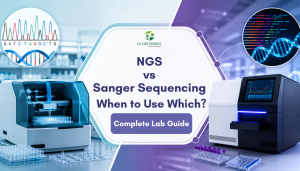
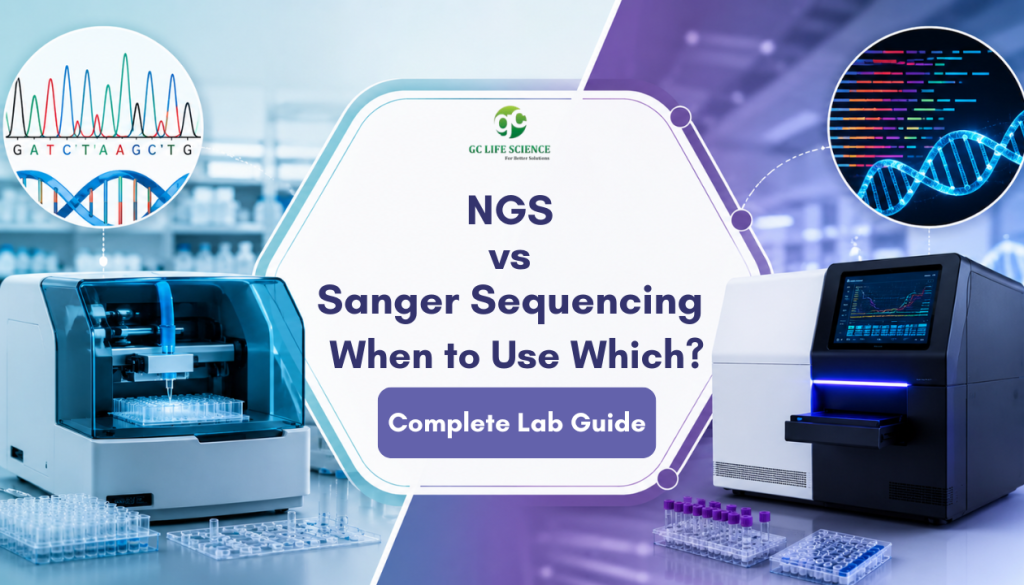
NGS and Sanger Sequencing serve different purposes, helping laboratories choose the most accurate sequencing method based on clinical and research needs.
At GC Life Sciences, we support molecular diagnostic laboratories with quality products and innovative solutions for advanced genomics and molecular biology workflows. Our portfolio covers molecular diagnostics, real-time PCR, nucleic acid extraction, genetic testing, oncology research, clinical diagnostics, and precision medicine.
It also helps optimize laboratory workflow while providing reliable diagnostics. With a focus on quality, innovation, and scientific excellence, our solutions enable laboratories to achieve accurate, reproducible, and reliable results in a variety of molecular applications.
At GC Life Science, we support molecular diagnostic laboratories with advanced solutions for genetic analysis, molecular biology research, nucleic acid workflows, and precision diagnostics. Knowing the strengths and limitations of NGS and Sanger Sequencing can help laboratories optimize their testing strategies and achieve accurate, reliable results.
What is Sanger Sequencing?
Sanger sequencing, also known as chain termination, has been the mainstay of DNA sequencing for decades. Developed by Frederick Sanger in 1977, this method determines the exact nucleotide sequence of a specific DNA fragment.
The method uses fluorescently labeled dideoxynucleotides (ddNTPs) that terminate DNA synthesis at different positions. The resulting fragments are separated and analyzed to generate a DNA sequence.
Key Features of Sanger Sequencing
- High accuracy for targeted regions
- Ideal for single-gene analysis
- Simple workflow
- Cost-effective for low sample volumes
- Long read lengths
- Widely accepted in clinical diagnostics
- Excellent for mutation confirmation
- Reliable data interpretation
Because of its accuracy, Sanger Sequencing remains a trusted method for validating genetic variants identified through other sequencing technologies.
What is Next-Generation Sequencing (NGS)?
Next-generation sequencing (NGS) refers to a group of advanced sequencing technologies that can analyze millions of DNA fragments simultaneously.
Unlike Sanger sequencing, which processes DNA one piece at a time, NGS performs massively parallel sequencing, producing large amounts of genomic data in a single pass.
NGS has transformed molecular diagnostics by enabling comprehensive genomic analysis with high throughput and scalability.
Key Features of NGS
- High-throughput sequencing
- Simultaneous analysis of multiple genes
- Detection of rare variants
- Comprehensive genomic profiling
- Faster large-scale analysis
- Cost-effective for high sample volumes
- Supports precision medicine applications
- Scalable laboratory workflows
NGS is widely used in oncology, inherited disease testing, infectious disease surveillance, and advanced genetic research.
NGS vs Sanger Sequencing: Major Differences
Knowing the differences between NGS and Sanger Sequencing helps laboratories choose the most appropriate technology for their applications.
| Feature | Sanger Sequencing | Next-Generation Sequencing (NGS) |
| Throughput | Low | Very High |
| Number of Targets | Single or Few Genes | Hundreds to Thousands of Genes |
| Turnaround Time | Fast for Small Samples | Efficient for Large Batches |
| Cost per Sample | Lower for Small Projects | Lower for Large Projects |
| Data Volume | Limited | Massive |
| Variant Detection | Known Variants | Known and Novel Variants |
| Clinical Applications | Targeted Testing | Comprehensive Genomic Analysis |
| Scalability | Limited | Highly Scalable |
Both technologies have distinct advantages depending on laboratory requirements and clinical objectives.
When Should Laboratories Use Sanger Sequencing?
Although NGS has gained widespread adoption, Sanger Sequencing continues to serve important diagnostic and research purposes.
Mutation Confirmation
Sanger Sequencing is considered the gold standard for confirming variants identified by NGS.
Single-Gene Testing
When analyzing specific genes or mutations, Sanger sequencing provides highly accurate results without the need for extensive sequencing.
Small Sample Volumes
For laboratories processing a limited number of samples, Sanger Sequencing can be more cost-effective.
Targeted Genetic Analysis
It is ideal for studying specific genomic regions where comprehensive sequencing is not required.
Clinical Validation
Many clinical laboratories continue to use Sanger sequencing for validation and quality assurance purposes.
When Should Laboratories Use NGS?
NGS is the preferred choice when comprehensive genetic information is needed.
Oncology Diagnostics
NGS enables simultaneous analysis of multiple cancer-related genes, supporting precision oncology and targeted therapies.
Inherited Disease Testing
Comprehensive genomic screening can detect many genetic mutations associated with inherited diseases.
Rare Disease Investigation
NGS helps identify disease-causing mutations that may be missed using targeted testing approaches.
Infectious Disease Research
NGS supports pathogen identification, outbreak investigation, and antimicrobial resistance studies.
Large-Scale Research Projects
Population genomics, biomarker discovery, and clinical research programs greatly benefit from high-throughput sequencing.
Advantages of Sanger Sequencing abd Next-Generation Sequencing
| Advantages of Sanger Sequencing | Advantages of Next-Generation Sequencing (NGS) |
| High Accuracy – Delivers highly reliable sequence data for targeted DNA regions. | Comprehensive Analysis – Simultaneously analyzes multiple genes or entire genomes in a single run. |
| Easy Data Interpretation – Produces simple, straightforward results that are easier to analyze. | Increased Throughput – Processes hundreds to thousands of samples efficiently with high scalability. |
| Lower Equipment Requirements – Requires less complex laboratory infrastructure and minimal bioinformatics support. | Detection of Rare Variants – Identifies low-frequency mutations with exceptional sensitivity and accuracy. |
| Established Clinical Utility – Backed by decades of clinical validation and widespread regulatory acceptance. | Precision Medicine Support – Provides comprehensive genomic insights for personalized treatment decisions. |
| Cost-Effective for Targeted Testing – Ideal for small-scale projects, mutation confirmation, and single-gene analysis. | Future-Ready Technology – Continuously advancing with faster workflows, improved automation, and enhanced sequencing performance. |
Challenges and Considerations
Before selecting a sequencing technology, laboratories should evaluate several factors.
Sample Volume: Sanger Sequencing is suitable for smaller workloads, while NGS excels in large-scale testing.
Budget: Initial NGS investment is higher, although per-sample costs decrease with larger projects.
Bioinformatics Requirements: NGS generates extensive datasets that require specialized analysis tools and expertise.
Clinical Objectives: Targeted testing may require only Sanger sequencing, while comprehensive genomic analysis may use NGS.
Turnaround Expectations: The choice depends on project complexity and reporting requirements.
Quality Control in Sequencing Workflows
Accurate sequencing results depend on reliable quality control throughout your laboratory workflow. High-quality nucleic acid extraction, proper sample processing, validated sequencing protocols, and internal quality control are essential for reliable performance.
Regular instrument maintenance, adherence to standard operating procedures (SOPs), proficiency testing, contamination prevention and thorough data verification further improve the accuracy of results.
Supported by qualified laboratory personnel and strong quality assurance programs, these practices ensure reproducible, consistent, and clinically meaningful sequencing results.
The Role of Sequencing in Modern Molecular Diagnostics
Advances in sequencing technology continue to transform healthcare and biomedical research.
Applications include:
- Cancer genomics
- Genetic disorder screening
- Prenatal testing
- Pharmacogenomics
- Infectious disease monitoring
- Biomarker discovery
- Precision medicine
- Clinical research
- Population genomics
- Personalized healthcare
As sequencing technologies evolve, laboratories gain access to increasingly powerful tools for disease detection and treatment planning.
GC Life Science Solutions for Molecular Diagnostics
At GC Life Science, we support molecular diagnostic laboratories with high-quality products and innovative solutions for advanced genomic and molecular biology workflows.
Our portfolio covers molecular diagnostics, real-time PCR, nucleic acid extraction, genetic testing, oncology research, clinical diagnostics, and precision medicine. It also helps optimize laboratory workflow while providing reliable diagnostics.
With a strong focus on quality, innovation, and scientific excellence, our solutions enable laboratories to achieve accurate, reproducible, and dependable results across diverse molecular applications.
Conclusion
Sanger sequencing and next-generation sequencing (NGS) remain valuable tools for molecular diagnostics and genetic research. Sanger sequencing continues to provide unparalleled confidence in targeted testing and variant confirmation, and NGS provides comprehensive genomic information through high-throughput sequencing capabilities.
The decision between NGS and Sanger Sequencing depends on laboratory goals, sample volume, budget, and clinical requirements.
By knowing the strengths of each technology, laboratories can select the most appropriate approach to improve diagnostic accuracy and support precision medicine initiatives.
At GC Life Science, we remain dedicated to empowering laboratories with advanced molecular diagnostic solutions that drive innovation, reliability, and scientific progress.
FAQ’s
1. What is the main difference between NGS and Sanger Sequencing?
Sanger Sequencing analyzes specific DNA fragments individually, while NGS sequences millions of DNA fragments simultaneously.
2. Which sequencing method is more accurate?
Both methods are highly accurate, but Sanger Sequencing is often used as the gold standard for variant confirmation.
3. When should Sanger Sequencing be used?
It is ideal for targeted gene analysis, mutation confirmation, and low-volume testing applications.
4. When is NGS preferred?
NGS is preferred for comprehensive genomic analysis, oncology testing, inherited disease screening, and large-scale studies.
5. Is NGS more expensive than Sanger Sequencing?
NGS has higher initial costs but becomes more cost-effective for large sample volumes and multi-gene testing.
6. Can NGS detect rare genetic variants?
Yes, NGS can identify rare and low-frequency mutations with high sensitivity.
7. Why is Sanger Sequencing still used today?
Its high accuracy, simplicity, and clinical validation make it valuable for targeted testing and result confirmation.
8. What are common applications of NGS?
Cancer genomics, rare disease diagnosis, infectious disease research, pharmacogenomics, and precision medicine.
9. What role does quality control play in sequencing?
Quality control ensures reliable, reproducible, and clinically meaningful sequencing results.
10. How does GC Life Science support molecular diagnostics?
GC Life Science provides advanced molecular diagnostic solutions that support accurate testing, research excellence, and laboratory efficiency.