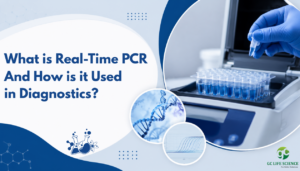
Real-Time PCR (qPCR) enables rapid, accurate detection and quantification of DNA or RNA, making it essential for modern molecular diagnostics and research.
Real-time PCR (qPCR) is one of the most powerful and widely used molecular diagnostic techniques in modern clinical laboratories. The ability to simultaneously amplify and quantify DNA or RNA in real time has made it the gold standard for detecting infectious diseases, genetic disorders, and various clinical conditions.
At GC Life Science, we provide high-performance Real-Time PCR kits and molecular diagnostic solutions designed to deliver accurate, sensitive, and reproducible results for advanced laboratory applications.
Knowing Real-Time PCR (qPCR)
Real-time PCR, also known as quantitative PCR (qPCR), is a laboratory technique used to amplify and detect DNA or RNA targets during the PCR process itself. Unlike traditional PCR, which only displays results at the end, qPCR uses dyes or fluorescent probes to monitor amplification in real time.
This allows laboratories to measure the amount of genetic material present in a sample with high precision, making it extremely valuable for diagnostic and research purposes.
How Real-Time PCR Works
Real-Time PCR involves three main steps:
Denaturation: The double-stranded DNA is separated into single strands by heating.
Annealing: Short primers bind to the target DNA sequence.
Extension: A DNA polymerase enzyme synthesizes a new DNA strand.
During each cycle, fluorescent signals increase proportionally to the amount of amplified DNA, allowing real-time measurement of the reaction.
Why Real-Time PCR is Important in Diagnostics
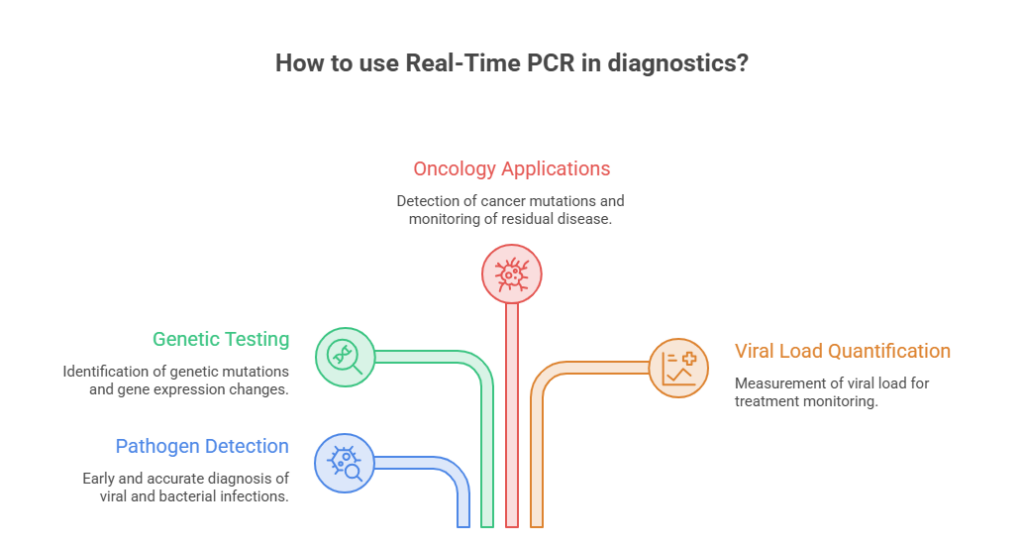
In modern clinical laboratories, Real-Time PCR has become the gold standard for molecular diagnostics due to its accuracy, speed, and sensitivity.
Pathogen Detection
Real-Time PCR is widely used for detecting viral and bacterial infections, including respiratory diseases, gastrointestinal infections, and sexually transmitted infections. It enables early and accurate diagnosis even at very low pathogen levels.
Genetic Testing
qPCR helps identify genetic mutations, SNPs, and gene expression changes, supporting personalized medicine and inherited disease analysis.
Oncology Applications
It is used to detect cancer-related mutations, monitor minimal residual disease, and analyze gene expression in tumor samples.
Viral Load Quantification
Real-Time PCR is essential for measuring viral load in diseases such as HIV, hepatitis, and other viral infections, helping doctors monitor treatment response.
Advantages of Real-Time PCR in Clinical Laboratories
- High sensitivity and specificity
- Rapid turnaround time
- Quantitative and reproducible results
- Reduced contamination risk
- Suitable for high-throughput testing
- Compatible with multiple sample types
These advantages make qPCR an essential tool for diagnostic laboratories, research centers, and healthcare institutions worldwide.
GC Life Science Real-Time PCR Solutions
GC Life Sciences offers advanced real-time PCR kits and master mixes designed for superior performance in molecular diagnostic and research applications. Our solution provides high gain efficiency and excellent sensitivity, ensuring accurate target detection.
With strong multiplex detection capability, fast cycling protocols, and stable, reliable reagents, our kits support efficient laboratory workflows. They are fully compatible with major PCR instruments, providing consistent and reproducible results while meeting strict quality standards for dependable diagnostic accuracy.
The Future of Molecular Diagnostics
With continuous advancements in biotechnology, Real-Time PCR is becoming even more powerful in disease detection and genetic research.
From infectious disease screening to precision medicine, qPCR continues to play a crucial role in shaping the future of healthcare.
Conclusion
Real-time PCR is a revolutionary technology that has changed modern diagnostics due to its speed, accuracy and sensitivity. This enables early detection of diseases, supports genetic research and improves patient outcomes.
At GC Life Science, we are committed to delivering high quality molecular diagnostic solutions that empower laboratories with precision, reliability, and innovation.
FAQ’s
1. What is Real-Time PCR (qPCR)?
Real-Time PCR, also known as qPCR, is a molecular technique used to amplify and quantify DNA or RNA in real time during the PCR process.
2. How is Real-Time PCR different from conventional PCR?
Unlike conventional PCR, Real-Time PCR allows continuous monitoring of DNA amplification using fluorescent signals, providing quantitative results.
3. Why is Real-Time PCR important in diagnostics?
It is widely used for early detection of infectious diseases, genetic disorders, and cancer due to its high sensitivity and accuracy.
4. What diseases can be detected using Real-Time PCR?
It is used to detect viral infections, bacterial infections, respiratory diseases, STIs, and other pathogens.
5. What are the main components of a qPCR reaction?
A qPCR reaction includes DNA/RNA template, primers, probes or dyes, DNA polymerase, nucleotides, and buffer solution.
6. What is Ct value in Real-Time PCR?
Ct (Cycle threshold) value indicates the cycle number at which fluorescence exceeds the threshold, helping determine the quantity of target nucleic acid.
7. Is Real-Time PCR suitable for genetic testing?
Yes, it is widely used for SNP detection, gene expression analysis, mutation screening, and personalized medicine applications.
8. What are the advantages of GC Life Science PCR solutions?
GC Life Science PCR kits offer high sensitivity, multiplex capability, fast cycling, and reliable reproducibility across different PCR instruments.
9. Can Real-Time PCR be used for viral load testing?
Yes, it is commonly used to measure viral load in diseases like HIV, hepatitis, and other viral infections for monitoring treatment response.
10. What makes Real Time PCR a gold standard technique?
Its combination of speed, accuracy, quantitative capability, and high sensitivity makes it the gold standard in molecular diagnostics.