BCR-ABL monitoring with qPCR enables accurate CML monitoring, detects molecular response, supports treatment decisions, and ensures reliable, sensitive laboratory diagnostics.
Chronic myeloid leukemia (CML) is one of the most studied blood cancers, and its treatment has changed thanks to molecular diagnosis. Among available methods, BCR-ABL monitoring by qPCR has become the gold standard for assessing treatment response, detecting minimal residual disease (MRD), and guiding long-term patient management.
The ability to accurately quantify BCR-ABL transcripts allows clinicians to monitor disease progression and make timely treatment decisions.
At GC Life Science, we provide advanced Real-Time PCR kits, molecular diagnostic reagents, and laboratory solutions designed to deliver high sensitivity, accuracy, and reproducibility for modern molecular diagnostic laboratories.
This guide explains how BCR-ABL monitoring works, why qPCR is the preferred method, and the best laboratory practices for obtaining reliable results.
What is BCR-ABL?
The BCR-ABL fusion gene is created by a chromosomal translocation known as the Philadelphia chromosome (t(9;22)).
This genetic abnormality produces an abnormal protein tyrosine kinase, which causes uncontrolled proliferation of white blood cells and causes chronic myeloid leukemia (CML).
Since almost all CML patients carry this fusion gene, detecting and measuring BCR-ABL transcripts is essential for diagnosis and continuous disease monitoring.
Why is qPCR the Gold Standard for BCR-ABL Monitoring?
Quantitative real-time PCR (qPCR) is the molecular diagnostic method of choice because it allows accurate measurement of BCR-ABL transcript levels even in very low-abundance disease.
Compared to conventional PCR, qPCR offers:
- Extremely high sensitivity
- Accurate quantification
- Rapid turnaround time
- Excellent reproducibility
- Early detection of molecular relapse
- Minimal contamination risk
- High-throughput laboratory compatibility
These advantages make Real-Time PCR the international standard for monitoring treatment response in CML patients.
How BCR-ABL Monitoring with qPCR Works
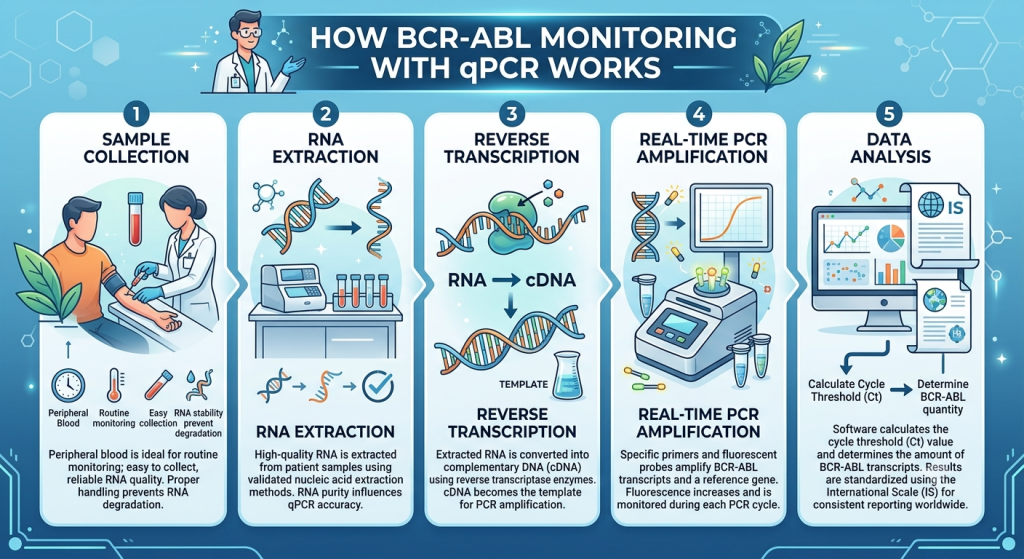
The laboratory workflow consists of several carefully controlled steps.
1. Sample Collection
Peripheral blood is an ideal sample for routine molecular monitoring because it is easy to collect and provides reliable RNA quality.
Proper sample handling is essential to prevent RNA degradation.
2. RNA Extraction
High-quality RNA is extracted from patient samples using validated nucleic acid extraction methods.
RNA purity directly influences qPCR accuracy.
3. Reverse Transcription
Extracted RNA is converted into complementary DNA (cDNA) using reverse transcriptase enzymes.
This cDNA becomes the template for PCR amplification.
4. Real-Time PCR Amplification
Specific primers and fluorescent probes amplify BCR-ABL transcripts containing the reference gene.
The increase in fluorescence is monitored during each PCR cycle.
5. Data Analysis
The software calculates the cycle threshold (Ct) value and determines the amount of BCR-ABL transcripts present.
Results are then standardized using the International Scale (IS) for consistent reporting worldwide.
Knowing the International Scale (IS)
The International Score (IS) standardizes BCR-ABL results in laboratories around the world.
This allows doctors to compare results regardless of the analysis laboratory.
Common molecular response levels include:
| Molecular Response | BCR-ABL (IS) |
| MR3 (Major Molecular Response) | ≤0.1% |
| MR4 | ≤0.01% |
| MR4.5 | ≤0.0032% |
| MR5 | ≤0.001% |
Using the International Scale improves consistency and supports global treatment guidelines.
Clinical Applications of BCR-ABL qPCR

Diagnosis of CML
qPCR confirms the presence of the BCR-ABL fusion transcript and supports molecular diagnosis.
Treatment Monitoring
Regular monitoring helps physicians assess a patient’s response to tyrosine kinase inhibitors (TKIs).
Minimal Residual Disease (MRD)
Even after successful treatment, tiny numbers of leukemic cells may remain.
qPCR detects these residual cells long before clinical symptoms appear.
Early Detection of Relapse
Increasing BCR-ABL transcript levels may indicate loss of treatment response.
Early identification allows physicians to modify therapy before disease progression.
Treatment-Free Remission (TFR)
Patients who maintain a deep molecular response for an extended period of time may be eligible for treatment discontinuation with close monitoring.
Quality Control in BCR-ABL qPCR Testing
Accurate BCR-ABL qPCR testing depends on strict quality control throughout the laboratory workflow. Reliable results require high-quality RNA extraction, validated primers and probes, internal amplification controls, and appropriate positive and negative controls.
Regular calibration of instruments, following standard operating procedures, storing reagents correctly, avoiding contamination, and taking part in proficiency tests are all just as important.
Skilled lab staff and a strong quality control system help make sure the test results are reliable, repeatable, and trustworthy for medical use.
Common Laboratory Challenges
Although qPCR is highly accurate, laboratories may encounter challenges such as:
RNA degradation: Poor sample handling can reduce RNA quality.
PCR inhibition: Impurities may interfere with amplification.
Pipetting errors: Incorrect reagent volumes affect reproducibility.
Instrument variation : Routine calibration minimizes analytical variability.
Cross-contamination : Strict laboratory workflow helps prevent false-positive results.
Why Clinical Laboratories Choose Real-Time PCR
Clinical labs often use Real-Time PCR (qPCR) because it allows for quick and precise molecular testing with high sensitivity and strong accuracy. It gives numerical reports that help track diseases accurately, and it reduces the chance of contamination by using a sealed tube for detection.
Its compatibility with automated systems and multiplex detection capability improves laboratory efficiency and throughput. Combined with scalable workflows, consistent reproducibility, and reliable clinical decision support, Real-Time PCR has become the preferred technology for modern molecular diagnostic laboratories.
GC Life Science Real-Time PCR Solutions
At GC Life Science, we are committed to supporting clinical laboratories with advanced molecular diagnostic technologies.
Our Real-Time PCR kits are designed to deliver:
- High sensitivity and specificity
- Excellent amplification efficiency
- Strong multiplex detection capability
- Fast PCR cycling
- Stable and reliable reagents
- Consistent batch-to-batch performance
- Compatibility with major Real-Time PCR instruments
- Reliable molecular diagnostic performance
- Reproducible quantitative results
- High-quality laboratory workflows
Our molecular diagnostic solutions help laboratories achieve dependable results for research and clinical applications.
Future of BCR-ABL Monitoring
The future of molecular diagnostics continues to evolve with improvements in assay sensitivity, automation, digital PCR technologies, and precision medicine.
Even though new technologies are developing quickly, qPCR is still the main method used worldwide for regularly checking BCR-ABL because it is accurate, cost-effective, and dependable in clinical settings.
As molecular diagnostics continue to expand, laboratories equipped with high-quality Real-Time PCR solutions will remain at the forefront of personalized cancer care.
Conclusion
Testing for BCR-ABL using qPCR is very important for diagnosing and managing CML over time. Its high sensitivity, accurate measurements, and clear, standard reports help doctors track how well a treatment is working, find very small amounts of remaining disease, and decide the best course of treatment.
By following standardized laboratory workflows, implementing strict quality control measures, and using high-performance Real-Time PCR kits, laboratories can ensure accurate and reproducible molecular testing.
At GC Life Science, we continue to provide innovative molecular diagnostic solutions, Real-Time PCR kits, and laboratory reagents that empower clinical laboratories with precision, reliability, and confidence.
FAQ’s
1. What is BCR-ABL monitoring with qPCR?
It is a molecular diagnostic test that measures BCR-ABL transcript levels to monitor treatment response in Chronic Myeloid Leukemia (CML).
2. Why is qPCR used for BCR-ABL monitoring?
qPCR offers high sensitivity, accurate quantification, and rapid detection of minimal residual disease, making it the preferred method.
3. What is the International Scale (IS)?
The International Scale standardizes BCR-ABL results across laboratories, ensuring consistent reporting and comparison worldwide.
4. How often should BCR-ABL monitoring be performed?
Monitoring frequency depends on clinical guidelines and treatment stage, typically every three months during the initial treatment period.
5. What sample is used for BCR-ABL testing?
Peripheral blood is commonly used because it provides reliable RNA for molecular analysis.
6. What is minimal residual disease (MRD)?
MRD refers to a very small number of remaining leukemia cells that may persist after treatment and can be detected using qPCR.
7. What factors affect qPCR accuracy?
RNA quality, reagent performance, instrument calibration, and adherence to standardized laboratory protocols all influence test accuracy.
8. Can qPCR detect disease relapse?
Yes. Rising BCR-ABL transcript levels can indicate molecular relapse before clinical symptoms develop.
9. Why is quality control important in BCR-ABL testing?
Quality control ensures reliable, reproducible, and clinically accurate results while minimizing errors and contamination.
10. How do GC Life Science Real-Time PCR solutions support laboratories?
GC Life Science provides high-performance Real-Time PCR kits, molecular diagnostic reagents, and laboratory solutions that deliver accurate, sensitive, and reproducible results for clinical and research applications.