FISH and PCR-based diagnostics help laboratories detect specific genetic mutations, chromosomal abnormalities, and cancer biomarkers for modern oncology testing.
Modern oncology increasingly relies on molecular testing to identify genetic changes, biomarkers, and chromosomal abnormalities associated with cancer. Among the important technologies used in molecular oncology are FISH (Fluorescence In Situ Hybridization) and PCR (Polymerase Chain Reaction). These techniques can provide targeted information about specific genes, mutations, gene rearrangements, and other molecular changes.
Fish testing and PCR-based diagnosis are used in various cancer-related areas, such as studying leukemia, checking for solid tumors, doing molecular tests, and analyzing cancer markers. For labs, choosing the right reagents, diagnostic kits, and other necessary products is key to creating dependable testing processes.
GC Life Science provides Oncology Diagnostics Solutions in Rajasthan, along with molecular biology products and laboratory solutions from established brands such as QIAGEN and Promega.
What Are FISH and PCR-Based Diagnostics?
FISH and PCR are molecular laboratory techniques that can be used to investigate specific genetic or chromosomal changes.
FISH, or Fluorescence In Situ Hybridization, uses fluorescently labeled DNA probes that bind to specific DNA sequences in cells or tissue samples. The resulting fluorescent signals can be examined under a suitable microscope to identify the presence, absence, location, or copy number of specific genetic regions. FISH can also help identify certain chromosomal abnormalities associated with cancer.
PCR, which stands for Polymerase Chain Reaction, is a method scientists use to make lots of copies of a specific part of DNA.This allows them to see and study that part more clearly. The type of test used will determine what kind of mutations, gene sequences, fusions, or other molecular targets can be found using PCR methods.
Both technologies have important applications in modern oncology diagnostics and research.
How Does FISH Work in Oncology?
FISH uses specially made probes that are marked with fluorescent colors to find and bind to certain DNA sequences. These probes are used on cells or tissue samples that have already been prepared, and they stick to the matching target sequences.
The sample is then examined using fluorescence microscopy. The pattern and number of fluorescent signals can provide information about specific genetic or chromosomal abnormalities.
FISH can be useful for investigating:
- Gene rearrangements
- Gene amplifications
- Chromosomal abnormalities
- Gene deletions
- Specific copy-number changes
- Selected cancer-associated biomarkers
Because FISH allows specific genetic regions to be visualized within cells, it can provide information about the location and status of selected targets.
How Does PCR-Based Diagnostics Work?
PCR-based diagnostics focus on the amplification and detection of specific DNA sequences. A PCR reaction uses primers designed for the target sequence along with DNA polymerase and other required reagents.
During repeated cycles of amplification, the target DNA sequence is copied, producing enough material for detection and analysis.
Different PCR methods can be chosen based on what the test needs. These could be things like regular PCR, real-time PCR which is also called qPCR, reverse transcription PCR known as RT-PCR, multiplex PCR, and other specific types.
For cancer treatments, PCR can help look into certain genetic changes, mutations, or fusion targets. The choice of assay is based on the type of biological sample, the target being studied, and the purpose for which the assay will be used.
FISH vs PCR-Based Diagnostics
| Comparison Factor | FISH Diagnostics | PCR-Based Diagnostics |
| Basic Principle | Uses fluorescent probes to identify specific genes or chromosomal regions within cells or tissue. | Amplifies specific DNA or RNA sequences for detection and analysis. |
| Type of Information | Provides information about the location, copy number, rearrangement, or presence of specific genetic regions. | Provides information about specific nucleic acid sequences and targeted genetic changes. |
| Genetic Alterations | Useful for detecting chromosomal abnormalities, gene rearrangements, amplifications, and deletions. | Useful for detecting specific mutations, gene fusions, pathogens, and other targeted nucleic acid changes. |
| Sample Type | Commonly performed on cells, tissue sections, or other suitable clinical specimens. | Can be performed using DNA or RNA extracted from various sample types. |
| Target Being Investigated | Specific genes, chromosomes, or genomic regions within cells. | Specific DNA or RNA sequences targeted by primers. |
| Sensitivity | Depends on probe design, sample quality, target abundance, and testing conditions. | Often provides high analytical sensitivity for specific nucleic acid targets. |
| Visualization | Allows direct visualization of targeted genetic regions under a fluorescence microscope. | Results are detected through amplification and signal-generation methods rather than direct cellular visualization. |
| Laboratory Workflow | Requires specialized slide preparation, fluorescent probes, microscopy, and interpretation. | Requires nucleic acid extraction, amplification equipment, primers, reagents, and appropriate detection systems. |
| Equipment | Fluorescence microscope and related FISH laboratory equipment. | PCR/qPCR instruments and supporting molecular biology equipment. |
| Oncology Applications | Used for selected chromosomal abnormalities, gene rearrangements, and copy-number changes. | Used for targeted mutation, fusion, and biomarker testing, including BCR-ABL and EGFR-related testing. |
| Best Suited For | Situations where direct visualization of a specific genetic region or chromosomal abnormality is required. | Situations requiring targeted amplification and detection of specific nucleic acid sequences. |
| Use Together | May provide complementary information alongside molecular testing. | Can be combined with FISH or other molecular methods when multiple types of genetic information are required. |
Applications of FISH in Modern Oncology
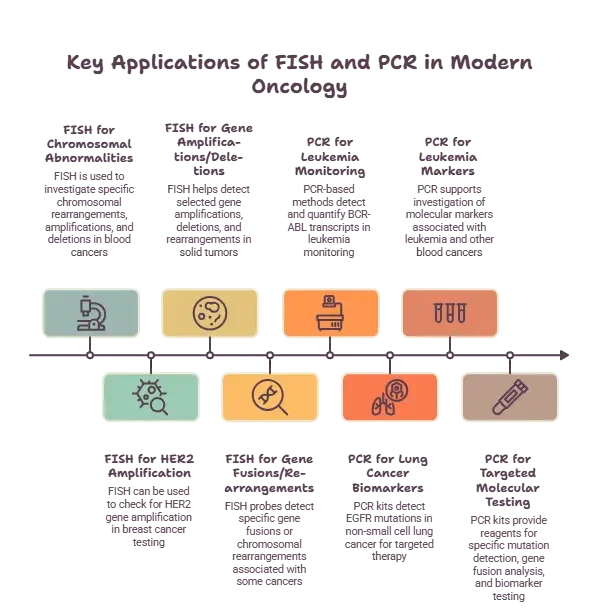
FISH has applications across hematological malignancies and solid tumors. It can help investigate specific chromosomal rearrangements, amplifications, deletions, and other abnormalities relevant to cancer.
1. Leukemia and Hematological Malignancies
Genetic and chromosomal abnormalities are important in many hematological cancers. FISH can be used to investigate selected abnormalities in leukemia and other blood cancers.
Certain FISH probes can focus on specific areas of chromosomes or gene changes linked to certain types of cancer. This makes a FISH diagnostic kit helpful in lab processes that need specific chromosomal testing.
FISH is also used as an adjunct to other cytogenetic and molecular methods in hematological malignancy testing.
2. Breast Cancer Biomarker Testing
Fish can be used in some breast cancer testing processes to check for HER2 gene amplification when it is needed. HER2 status can be checked through tests like immunohistochemistry or FISH, and the choice of method depends on the testing process and what the doctors need.
This demonstrates how molecular and cytogenetic techniques can contribute to biomarker assessment in oncology.
3. Solid Tumor Research
FISH can help detect selected gene amplifications, deletions, and rearrangements in solid tumors.
For example, certain FISH methods can be used to look at genetic changes in tumors when a specific change in a chromosome or gene is important for diagnosing the tumor or understanding its molecular features.
4. Gene Rearrangement Detection
Some cancers are associated with gene fusions or chromosomal rearrangements. FISH probes can be designed to detect specific rearrangements or break-apart patterns.
This makes FISH useful when laboratories need targeted information about a known genetic alteration.
Applications of PCR-Based Diagnostics in Oncology
PCR-based testing is widely used for targeted molecular analysis. Depending on the assay design, PCR can detect specific DNA sequences, mutations, or gene-related targets.
1. BCR-ABL Testing
BCR-ABL is an important molecular target in the study and monitoring of certain leukemias. PCR-based methods can be used to detect and quantify BCR-ABL transcripts in appropriate testing workflows.
Laboratories working with leukemia-related molecular testing may require specialized BCR-ABL QIAGEN RT-PCR kit solutions and supporting products according to their testing requirements.
2. EGFR Mutation Testing
EGFR mutations are relevant to molecular testing in certain cancers, particularly in non-small cell lung cancer.
An EGFR mutation detection kit can be made to find certain EGFR mutations in suitable clinical samples. Testing for certain biomarkers at the molecular level can give useful information that is used together with other medical tests and findings when checking for cancer.
3. Leukemia Molecular Testing
PCR-based testing can support the investigation of molecular markers associated with leukemia and other hematological malignancies.
A good leukemia diagnostic kit might have reagents and parts made for certain molecular targets. The specific test that is chosen depends on the condition that is being suspected, the type of sample provided, the target molecule being checked, and the procedures used by the lab.
4. Cancer Diagnostic PCR Kits
Cancer diagnostic PCR kits can support targeted molecular testing by providing the reagents required for specific PCR-based assays.
Depending on the product and application, these kits may be designed for mutation detection, gene fusion analysis, biomarker testing, or other molecular targets.
Laboratories should select diagnostic kits according to validated applications, sample requirements, instrument compatibility, and testing protocols.
What Laboratories Need for FISH and PCR Testing
Reliable oncology testing requires appropriate products across different stages of the laboratory workflow.
Important requirements may include:
- High-quality DNA and RNA extraction solutions
- PCR kits and reagents
- FISH diagnostic kits
- Fluorescent probes
- PCR instruments
- Real-time PCR systems
- Microscopy and imaging systems
- Laboratory consumables
- Positive and negative controls
- Sample preparation products
- Quality control materials
The specific requirements depend on the molecular target, sample type, testing method, and intended application.
High-quality nucleic acid is particularly important for many PCR-based workflows. Laboratories should select suitable Nucleic Acid Extraction products according to their sample type and downstream testing requirements.
Choosing Oncology Diagnostics Solutions for Your Laboratory
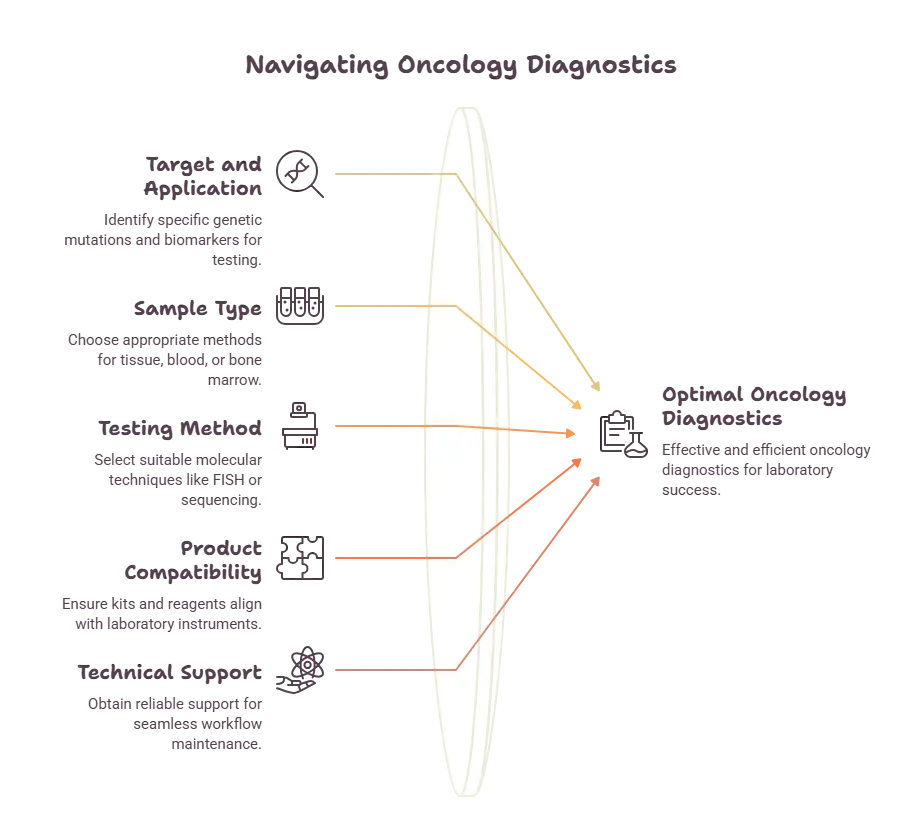
Selecting the right Oncology Diagnostics Solutions requires consideration of the laboratory’s testing objectives and workflow.
Before selecting a product, laboratories may consider:
Target and Application
First, identify the genetic mutation, gene fusion, chromosomal abnormality, or biomarker that needs to be investigated.
Sample Type
The sample may include tissue, blood, bone marrow, or other biological material. The selected testing workflow should be appropriate for the sample type.
Testing Method
FISH, PCR, RT-PCR, qPCR, sequencing, or another molecular method may be selected according to the target and intended application.
Product Compatibility
Kits and reagents should be compatible with the laboratory’s instruments, workflow, sample preparation methods, and quality-control procedures.
Technical Support
Reliable technical information and product support can help laboratories select suitable solutions and maintain consistent workflows.
GC Life Science for Oncology Diagnostics
GC Life Science provides laboratory products and Oncology Diagnostics Solutions in Rajasthan for research, diagnostic, and molecular laboratory applications.
Its product portfolio includes molecular biology and diagnostic solutions from established brands such as QIAGEN and Promega, supporting workflows involving nucleic acid extraction, PCR, molecular testing, and other laboratory applications.
The available solutions can help with requirements for BCR-ABL, EGFR mutation detection kits, Leukemia diagnostic kits, FISH diagnostic kits, and Cancer diagnostic PCR kits, based on the specific product and its intended use.
For labs looking for dependable oncology lab products, it’s important to choose solutions based on the sample type, molecular target, workflow, and application.
Conclusion
FISH and PCR-based diagnostics have important applications in modern oncology. FISH can help identify selected chromosomal abnormalities, gene rearrangements, amplifications, and deletions, while PCR-based methods can support targeted detection and analysis of specific nucleic acid sequences.
These technologies help labs look closely at changes in cancer-related molecules by using methods like BCR-ABL and leukemia tests, EGFR mutation checks, FISH-based biomarker analysis, and other molecular oncology tools.They offer focused ways to study the molecular changes linked to cancer.
Good oncology diagnostic solutions need the right tools like test kits, chemicals, extraction materials, equipment, control samples, and lab supplies. GC Life Science offers laboratory services for molecular testing and diagnostics to help with cancer research and testing processes.
Looking for Oncology Diagnostics Solutions in Rajasthan?
Connect with GC Life Science for FISH diagnostic kits, PCR kits, molecular testing products, nucleic acid extraction solutions, and other laboratory requirements.
Request Product Information Today.
Reference:
https://pmc.ncbi.nlm.nih.gov/articles/PMC7221545
FAQ’s
1. What is FISH in oncology diagnostics?
FISH is a molecular cytogenetic technique that uses fluorescent DNA probes to identify specific genes, chromosomes, or genetic abnormalities within cells or tissue samples.
2. What is PCR-based cancer diagnostics?
PCR-based cancer diagnostics use polymerase chain reaction to amplify and detect specific DNA or RNA targets associated with cancer or molecular biomarkers.
3. What is a FISH diagnostic kit?
A FISH diagnostic kit generally contains probes and other required components for detecting specific genetic or chromosomal targets using fluorescence in situ hybridization.
4. What is BCR-ABL testing used for?
BCR-ABL testing detects a specific genetic alteration associated with certain leukemias and can be performed using appropriate molecular testing methods.
5. What is an EGFR mutation detection kit?
An EGFR mutation detection kit is designed to identify specified mutations in the EGFR gene from suitable biological samples using a validated molecular testing method.
6. What are cancer diagnostic PCR kits?
Cancer diagnostic PCR kits contain reagents and components designed for specific PCR-based molecular testing applications related to cancer biomarkers or genetic alterations.
7. Can FISH detect gene amplification?
Yes. FISH can be used to assess selected gene amplifications and copy-number changes when appropriate probes and testing protocols are used.
8. Are FISH and PCR the same technique?
No. FISH uses fluorescent probes to visualize specific genetic regions in cells or tissue, while PCR amplifies specific nucleic acid sequences for detection or analysis.
9. What products are required for oncology molecular testing?
Requirements may include nucleic acid extraction products, PCR kits, FISH probes or kits, controls, laboratory consumables, instruments, and other workflow-specific reagents.
10. Where can laboratories find oncology diagnostics solutions in Rajasthan?
GC Life Science provides laboratory products and oncology-related molecular diagnostic solutions in Rajasthan for research and diagnostic applications.